Wednesday, 21 January 2009

Update on Bristol Eagle Owl (Oscar)

Dear All. After the news that Oscar the Eagle Owl (Bristol's very own one bird pest control unit) had been re-captured over Xmas, came the news all you Eagle Owl fans wanted to hear, in an e mail from the BOC's Ed Drewitt this morning. Thanks Ed..

Oscar is Back!

Friday, 16 January 2009

A visit to Wales finally leads to a vist to Gigrin Farm

The countless times I have driven along the Rhayader road in wonderful Wales, and of course the many times I have gone straight past Gigrin Farm (the Kite feeding station). I had never gone to have a look in all the years it has been open, but finally at the beginning of the week I went.
I was gobsmacked to say the least by the whole set up. OK so I have seen Red Kites before, in fact I have seen them here in the Gordano Valley and on the Mendip Hills and those sightings are increasing all the time. However I had never seen anything quite like this. It was nice to meet the people behind the scenes, very friendly indeed, and the little Spaniel Dog was great fun making me throw objects for him, constantly. Its not just seeing the Red Kites, but the whole set up at Gigrin farm is very special, the farm has a very good exhibition which goes beyond Kites and looks at other wildlife as well, there is also an excellent nature reserve, which takes you above the Kite feeding station, it consists of a mix of wetland, hill scrub and grassland areas, I must return to walk this reserve properly in the Spring.
Just before 1400 hrs the Red Kites began to gather in the fields close to the feeding area, very few were perched in trees, most were in the air. Indeed as I scanned the background hills I could see even more Red Kites heading towards the farm.


Count the Kites, and no that's not dust on the sensor in the background its Kites!

I did try counting them, but they were moving at such speed and constantly changing position, however the reliable figure for that day was around 400 Red Kites . At 1400 hrs the food appeared from the bucket of a tractor, which apparently had been changed a few days before, so the new tractor was making the Kites more nervous (honestly I did not notice). Other Birds joined in for the free meat. A Heron, Common Buzzard were around already and flew straight on to the ground whilst interestingly the Carrion Crows, Ravens and Rooks were much more nervous than I would have thought. The cheeky ones were three Starling who got out before any of them grabbed the meat and flew off. Back to the Buzzards, with only one Red Kite coming to ground to feed and the others all swooping in grabbing a bit of meat, eating it in the air, and then coming back for more. Where ever a Buzzard was sat quite happily munching on the ground, the Kites would gang up and quite deliberately dive bomb and snatch the pieces of meat that was the closest to any Buzzard that waas sat on the ground, this seemed to be planned with Kites working together to try and put the Buzzards off.

Buzzard tries to defend itself, obviously it will need an aspirin in the morning for this headache

Three Kites dive past two Buzzards, note Buzzards stay put for now


Do you sometimes get that feeling your being watched?

The spectacle went on for nearly 2 hours before the Birds started to disperse away from the feeding area. In that time I had seen many Red Kites and really close. Some interesting behaviour between Red Kites and Buzzards, and of course one of my favourite group of Birds the Corvides who also did not let me down with their presence, and I nearly forgot the one Heron who joined in as well. Gigrin Farm is really well worth a visit if you have not been, indeed now seeing this for myself, I can't wait to return and see this great spectacle again. I did have the camera with me as you can see, however it was quite a dull day so the ISO is running quite high on my Canon EOS 30D this to keep the shutter speed high enough for the flying birds. However may I suggest to people who go to take pictures, to go twice, once to enjoy it, and the other time to take pictures. I found it extremely difficult to do both, hence there are not many pictures.

Red Kite at Gigrin Farm note the wing tags


Monday, 5 January 2009

Swan Rescue Portishead, What! You have not heard about this.

What happens when the temperature becomes so low that water begins to freeze. Well most birds begin to abandon the fresh water and head to the salt water of the sea. However here is one Swan that forgot the rules, he is a first year Mute Swan from Portishead lake grounds. I was called by Secret World Wildlife Rescue to help with the rescue of this Swan stuck in the frozen lake, whilst they stood by ready to receive him. I went into action, however not before Someone had been in touch with the Portishead Life Boat rescue team. The plan was, a fully harnessed life boat team member would slide out across the ice and rescue the trapped Swan. Easy? Think again, these guys are the professionals and the fact they have health and safety as paramount is a really good reason why they do this bit and some one like me does not.

Trapped Swan on the ice of Portishead Lake grounds


Upon arrival the team of two from Portishead lifeboat worked with one person on land, the other tied to the first began inching his way out across the ice.


Life boat crewman inching his way across ice to Swan

My part in this was actually simple, and that was to secure the Swan when back on land, ensure it was free of stress and transfer to Secret World as quickly and safely as the wheels on freezing roads would let me.

Swan being secured ready for transport

Portishead Life Boat crew, me and the newly named "Frosty" the Swan


The trip on the M5 heading south to Highbridge, and then on to Secret World was OK actually, and around 1 hour after rescue the Swan (now called "Frosty" by the Portishead Life Boat team) was secure at Secret World and under a heat lamp.


Frosty on the mend at Secret World

Well that all happened on Tuesday evening, 6th of January. Indeed the rescue has attracted a lot of attention, these Swans are Portishead's pride and joy. But the following day I did interviews for both TV channels BBC and ITV, the Radio and press all turned up. So it was a great chance to talk about how other wildlife get affected during these extreme freeze ups and of course lots of messages about how people can help.

On Saturday 10th we were supposed to release Frosty back at Portishead, but the milder weather that had been predicted was a day late. I did a recce at the lake grounds and found that after a another night of minus 6 degrees centigrade, it was no surprise that the whole lake was still thick with ice.


Portishead Lake, still frozen up Sat 10th


Adult Swan on the edge of the lake Saturday 10th


I contacted Pauline Kidner at Secret World and called off the release, postponing it for another day. Returning Frosty to the lake grounds also caused another headache, as all his 4 brothers and sisters had now moved a short distance to Portishead Marina, (what we yer locals used to call Portishead Docks). Indeed later that day I went to the marina and there was about 15 to 20 Swans gathered in a mix group adults and sub adults, with the yearlings from the Lake grounds.
It may have been possible that by returning Frosty to the lake Grounds I could have just caused the adults there to just push him a way. So I made the decision not only to release on Sunday, but to give Frosty a head start and put him with the gathering of Swans at the Marina.

At 1400 hours on Sunday 11th of January I arrived at Secret World and saw Frosty out in the Swan pen, he looked great and ready to go.


Frosty showing good energy and fitness as he resists capture at Secret World


Staff at Secret World, who have done a real professional job for Frosty

I have to say that from the word go on this rescue Secret World have acted like real professionals, the communication at the beginning was brilliant, everything was ready for Frosty when he arrived at Secret World and the fact they have got him back on his feet in double quick time ready for the thaw was amazing. I of course on this rescue was representing Hawk and Owl Trust and I'm glad so many people commented on the fact after seeing the TV bits, how much they enjoyed seeing two organisations working together. After leaving Secret World I arrived at the Marina, and in the car being helped by Secret World volunteers Libby Brown and Leah Sperring, we were greeted by the Swan enthused public and BBC Points West cameraman.


BBC Cameraman, Frosty and Me, no more Rod Hull and Emu jokes please!


After a very quick interview I unstrapped Frosty from his restraining bag, and he was off, in fact just like a Duck to water (sorry bad pun). Interestingly his spell in captivity meant that the first thing he did once in the water was preen like there was tomorrow. The reason for this is to re oil himself to make sure his feathers are fully water proof, I could actually see him rubbing his beak across his preen gland then draw his feather through his beck, really great bit of behaviour. The other Swans looked on with interest and couple of the older more white ones, went out to show Frosty who was boss, this is normal and nothing to worry about. This is a big gathering of Swans and unlike his parents they would not try and get rid of him.

Frosty heads to water, note the onlookers

Frosty exercises his wings in the Marina


Well that's it and hopefully Frosty is on his way. He should live for a while at the Portishead Marina, he will of course be looked after by all the Portishead people who come to see the Swans gathering and of course to feed them. If anything does go wrong for any of the Swans the early alarm from the public is assured. From these gatherings young Swans will meet other Swans and in the Spring they will pair off and find somewhere in the Gordano Valley to have nests and bring up their own cygnets.


A huge thanks must go to the public of Portishead who raised the alarm about this Swan in the first place, and of course the rescue would not have been possible without the Portishead Life Boat Trust. Also thanks to Hawk and Owl Trust volunteer Dave Newton who used my camera and took all the pictures at the Marnia. Its very difficult holding a swan and taking pictures at the same time, thanks Dave.

And to Secret World http://www.secretworld.org/ for their communication, speed and care at the wildlife centre in Highbridge.

Wednesday, 24 December 2008

Merry Christmas

I'm having a short break but will be back soon.
In the meantime I hope you all have a great Christmas and lets start 09 by saving what we have left in the natural world.

BFN and enjoy.

Chris

Friday, 12 December 2008

Eagle Owl in Bristol Part 2

Eagle Owl photographed at Puxton Park forgot its name someone e-mail me please!
Update: Thanks for the e mail Katy.
This wonderful gentle giant is called "Harriet"
You can see her perform at Puxton Park near Weston Super Mare

Well you can't keep a good Owl down, and this one was showing well on Wednesday night and Thursday morning. I was interviewed as part of an item on BBC1's inside out, this story was with regards to the Bristol resident Eagle Owl who the local people have called Oscar. Better give him a latin name to go with that, um, how about Bubo bubo bristolius, well, it sounds good.
The Eagle Owl (Oscar) was roosting in a tree close to the biology department of Bristol University (wise Owl). Almost on cue around dusk, he flew to the Archaeological building and then began calling. Now this was amazing, as he sat proud on top of a chimney lowered his back raised his tail high and blasted out his double noted low toned call across Bristol "Hoo Huu". This continued for a while. What I had established in this time was that he looked like, and was coloured like the nominate race of Eagle Owl, therefore (Bubo bubo bubo) Northern European race, also he was indeed male, and the fact he was displaying so prominently should mean he was feeding well, and was now trying to attract a passing female. For me this is were it gets sad. I'm supposed to give a balanced view, however I could not help thinking as this King of the night hunters was booming out its call, and there was no reply, of course there was not going to be a reply. This Eagle Owl was alone, yet with a whole city protecting him, and even with university students studying him. I need to be careful here of course, because as I said during the interview never try and predict anything, for all I know a female is now making her way to him.

Bristol University students have collected and looked at his pellets (regurgitated, indigestible prey remains) and also backed up with some photographic evidence of what he is eating, such as Brown Rats, and I bet he is also eating Grey Squirrels as they were everywhere within his easy reach, also plenty of feral Pigeons.

The ace cameraman for the BBC was Richard Taylor-Jones, have a look at Richards brilliant Blog http://www.thewildernesscity.blogspot.com/ Richard seemed proud to be using some infrared gear to capture the night shots of Oscar, this gear on loan from the big cat diary team. This is the picture I took of the Camera (above), indeed it gave some stunning insights into this Eagle Owls nocturnal activity's. The picture below is of the monitor view that Mike Dilger and myself were looking into.


Oscar on the BBC Monitor

There are still many un-answered questions relating to Oscar, but I'm certain that he is of captive origin and not from a wild bred British nest. Sadly there are those creating an air of myth surrounding this bird. Eagle Owls because of their size are capable of much, yet often the myths that surround them can over take the facts.

Once again I talked this through via e mail to my good friend in Sweden Alar Broberg who has had 20 years experience with this species in the wild. I especially focused on questions surrounding diet and the fact of what appears to be the big issue here in the UK, and that is Eagle Owl catching Cats and Dogs. With Alars permission here is his answers.

Alar's response:

The basic food for Eagle owls is rodents and birds to size of a crow.
An eagle owl is a lazy- bird, and will catch the most common food resource that will not fight back too much, it does’t want to get injured. 5 rats are better than one crow.

Some examples of different nesting areas, rubbish dump owls; basically rodents and a very few gulls, owls in the archipelago; gulls, eiders and other waterfowl, owls on the main land ;crows, rodents, mallards.

We radio tracked one male in Stockholm for 6 months. We observed him for about 400 hours, during night time. This male nested and had his territory in Stockholm city.
All kills except one was rodents. The non rodent was possibly a Jackdaw. He could kill and eat up to 5 rodents/moles during 1 hour.
In the nest we found hares, mallards, crows and gulls. They must have been caught by the female.
A full grown hare is too heavy for an Eagle owl to carry during flight. So they are usually cut in pieces.

When the male hunted on a huge open area, where there were often dogs in the area. We could not observe any attack on a dog. On one occasion the male was on the ground and one dog owner told us to keep our dog in a leash. We told her that it is an Eagle owl, so when her dog came to close the male he took off and the owner believed us.

I know of two or three cats that have been attacked by Eagle owls in Sweden (we have approx 800 pairs), all cats where to big for the owl. I assume the owl made a miscalculation in the size of the cat and basically scratched it.

I also know about one dog, but I have also seen common buzzard strike a dog.
Having a dog close to a nesting site will in at least 60% of all case create an attack. The owls prefer to strike on the smaller dog instead of the human. This is pretty common and therefore no dogs are allowed when we are ringing owlets. I have no information of a dog kill in those situations, usually some small scratches.

I can not promise that no attack on dog or cat can happen, but if it happens it’s most likely that that the owl is trying to scare it away from a nesting site.

You should always be careful with big birds with huge talons.


I met Alar In Sweden when we were making the BBC Radio 4 series Owl Prowl and Planet Earth Under Threat, one of the programmes focused on Eagle Owl. Alar took us to one of the Eagle Owl nest sites to ring/band the owlets. Though we were in the nest and handling the 2 young Eagle owlets the parents watched us, but did not defend their owlets as I thought they might. We were issued with protective sunglasses just in case, and yes the adults were close by, and giving alarm calls, but that was it.

Proud moment, me with wild Eagle owlet in Sweden
Picture taken by Tom Arnbom, also with thanks to Alar Broberg and BBC NHU Radio

I was asked and have been e mailed about the future for Oscar. This would be impossible to answer. Though at present he seems to have his regular behaviour, however should his prey status change then it might force a change in his behaviour and maybe his location. But with so many good people looking out for him I do feel sure he is in safe hands with the people of Bristol, and observations of any changes will be forwarded.

And lastly. There are those within conservation that keep complaining about Eagle Owls being liberated from captivity. Yet they are the ones that if they really want to see this brought to heel, could be influencing DEFRA to have all keeping of Eagle Owls and therefore the captive bred offspring as well, registered with DEFRA. Meaning that every Eagle Owl bred or simply kept would be known to DEFRA, and further more every Eagle Owl in captivity should be rung with a DEFRA issued ring. This would stop the doubt about where these Owls come from when they are found in the wild. W ith regard to this idea, it is achievable, probably not priority, because of financing. It is thought that between 3000 and 4000 individual Eagle Owls are kept in captivity in the UK. Remember that's only a guess as this is not a registrable species, so no one really knows. Also don't forget that even if we believe the aforementioned number then a proportion of that number are in pairs and being bred, so the number is going up! In theory

With so many people going to see Oscar and becoming enthused by him, then let us conservationists never forget that this bird has turned a lot of ordinary people into thinking about natural history and its conservation in the City of Bristol. Well done Oscar!

Once again with regards to this blog entry on Eagle Owls, these thoughts and opinions are my own and do not in any way represent the view of any organisation I work for, or am Patron, or Trustee of.


Sunday, 7 December 2008

Winters Bite

Winter Sun through the mist
Sunrise frosty morning on meadows near Portishead

Sorry folks been too busy to blog. Over the past week winter has really started to bite down hard with night frosts lasting well into the day, must be time to get the hip flask out. The early morning frost this morning was very special indeed, yet not many birds around, I was expecting a rush of frenzied feeding on my usual very early morning walk. The Redwings and Fieldfares that were so evident just a few days ago have acted like a plague locusts stripping every berry from the Hawthorn, Holly etc. The bad news for us they are now in the gardens.
Fieldfare
I say this as they have always been my barometer for how the winter will pan out. We have not had them in the garden for a few years, yet having strip the local fields and woodland edge they are here in the garden. For us this is either bad news or good news. If you like your winters cold then your in for a treat this winter. Blue and Great Tit are showing very well now in the garden as is the Blackcap, Greenfinch is back after a year break, with Wren desperately trying to be king pin. Biggest disappointment, especially after they had such a good breeding season, is Blackbird. This after last winter having eleven in the garden during one morning, but now we only have one.
Marsh Tit

Last Saturday I was on BBC Somerset http://www.bbc.co.uk/somerset/local_radio/doing the weekly news review. One subject I was very keen to get my teeth into, was the fact that Somerset like other areas of UK came out as not having community spirit or no sense of togetherness. Baa, what nonsense. I am so proud to have worked with so many local community's in Somerset, OK this is with a Nature Conservation hat on, and indeed the Community Owls Project (COP) my most recent Community wildlife project, which proves a point that time and time again, people can come together and work towards common goals within their area. I do get quite fed up with the doom and gloom merchants. I suppose if they can talk an economy into recession then they are indeed a powerful force... Yet I will walk out tomorrow with a smile on my face and say hello to everyone I walk past, Why? Simple, this life is not long and sadly you only get one go at it, be happy feel happy, and it will spread, hopefully stopping the gloomy ones from spreading anymore rubbish!
Having this active interest in Wildlife conservation is not just because I want to save animals its because I want to save us. Yes that was a full stop. Thanks for the e mails following the programme and I'm very glad that many of you feel the same way I do, those that did not someone needs to make them feel part of it.

This week I'm out and about checking Owl and Bird Of Prey sites, so I will report back in with how they are fairing during cold snap.   Already Common Buzzards are noted as being very close to roads and easily observed, as is Kestrel, this will be an interesting week...

BFN

PS Coming soon, inside the Hornet nest, which means Dave Newton I need the nest!!

Friday, 28 November 2008

Owl Prowl sucsess for the National Trust

Just over a week ago I did an Owl prowl for the National Trust, this in the most amazing setting of Montacute House and grounds. The rain fell throughout and this event was extremely well attended, but apart from getting wet, people were left in awe as wild Little Owls and Tawny Owls not only gave their vocal display, but also put in a appearance as well. The Tawny Owls, a Male and Female were particularly visual as they flew round the House itself, this giving magnificent views of them as they flew through the lights that illuminates the old mansion. I feel sure the Owls use these lights and the height that the house gives them. This of course for easy access to prey such as Mice and Rats. As usual on these Owl Prowls no one went away disappointed, even though it rained constantly. My very special thanks to Gemma at Montacute House for organising this Owl Prowl. And thanks to all of you who keep e mailing about Owl Prowls. Yes I'm doing more, if you want to go on one then e mail your interest and I will put you on the Owl Prowl mailing list. Also thanks for the e mail about doing Owl prowls in other areas, again no problem, just tell me what you want, where you want and how many people and we can organise something. I will do private as well as public Owl Prowls, however U.S.A is a bit far (yes I have had one request from U.S.A) unless you want to pay for the airfare, then I'm game to do it.

Tuesday, 25 November 2008

Compton Dundon Talk for the arson attacked Owls

Well the turn out for this talk was staggering! This of course was a talk I wanted to do for the people of Compton Dundon, who were so caring with their quick response when a family of wild Barn Owls were burnt to death in an arson attack on a farmers barn.

We had a small group of us that organised this event, and were delighted that the Hawk and Owl Trust had donated 2 raffle prizes, also that Cotleigh Brewery (makers of fine real ales named after Birds of Prey and Owls) donated 2 raffle prizes, with one being a never to be repeated complete gift pack of Barn Owl Beer.

We were all gob smacked when after 100 chairs were placed out we had to add two more rows!

I'm not going to say any more, the rest of this posting is the words of Jenny Rowson from Compton Dundon. But I will just finish my bit by saying a huge thank you everyone who helped and joined in the fun of the evening.


Words By Jenny Rowson of Compton Dundon

Last Friday evening November 21st Chris Sperring MBE, world famous naturalist, broadcaster and Conservation Officer for the Hawk and Owl Trust gave a most enjoyable talk about owls at the Meadway Hall in Compton Dundon. His talk was free of charge and was dedicated to the villagers because, as he put it, of their magnificent response during the summer 2008 when an arson attack on a farmers barn caused the young Barn Owls to be burnt to death in the fire.

The village had collected over £100 for the Hawk and Owl Trust and also provided a replacement owl box which, on advice, was erected close to the destroyed one. Chris applauded the concern and rallying round shown after the disaster and rewarded the community with an extremely informative, interesting and at times amusing talk assisted by a superb visual display and Chris's amazing ability to demonstrate owl calls.

Chris was very enthusiastic about the area surrounding Compton Dundon which apparently is very good owl country with its open grassland, scrub land and abundance of trees and he emphasised the importance of leaving strips of long grass around fields to encourage mice and voles for the owls.

Tom and Jenny Rowson who were instrumental in replacing the owl box, with the support of J & F Clark Trust, helped to organise the evening and were apprehensive about the number of people who would attend. However, they need not have worried because the response was beyond expectations resulting in an audience of over 130 people who generously bought raffle tickets, owl trinkets, owl and bird boxes and refreshments. The unanimous verdict was that the evening had been informative, inspiring, thoroughly enjoyable and a great success.

Chris brought along his two captive owls, Otus and Beau who were very beautiful and caused a great deal of admiration, interest and photographing. The audience were allowed to see these magnificent tame birds extremely close up which was a wonderful experience.
The Hawk and Owl Trust Chairman, Barbara Handley, was in charge of membership and Adopt-a-Box sign-up and although it is not yet known how many people joined the Trust on the night, several forms were taken away.
After deducting expenses such as hire of the hall and raffle prizes other than those donated, £250 was raised on the evening which Chris and the Trust were delighted with.


My words again. From Death comes life, and the fact that so many people which included so many landowners turned out for this event means that wildlife has been firmly put on the agenda in this small, yet precious part of Somerset. I have now to follow up on new farm visits to farmers, who all want to help Owls (which means all wildlife). Brilliant! I love people! And I love Wildlife......... This should give everyone faith in the fact that we as a species can turn a wrong into a right.

Saturday, 22 November 2008

Kestrel vs Tick

I was called out to a local Primary School to look at a Kestrel which was looking under the weather and hanging round the School. I must admit my first thought was "oh no not another tame Kestrel hanging around people". I was wrong, when I arrived the staff showed me the wild male Kestrel which was perched on the ground in the leaves, looking very fluffed up trying to keep warm due to its poor condition.
It was not until I picked it up I could see why it was holding its eye shut, and this also explained its poor condition. Look at the picture and look closely under the eye. What you will see is the large body of a Tick. The Kestrel appeared not only in pain, but also upon handling was very thin indeed. First job once back home was removal of the Tick, this was done very quickly, then ensuring the Kestrel was warm and fed. Within 4 hours the Kestrel had perked up so much that it thanked me by grabbing my finger and drawing a good mount of blood from me, clearly this bird was on the mend. It may seem surprising that a tick could down something like a Kestrel. However the location of the tick around the eye was causing this bird a lot of distress, this had impaired its hunting which had meant it began to lose condition.

This Kestrel is now in a large aviary and will be released in a few days. I just want to make sure the Kestrel is back up to its right weight and of course there is nothing else wrong, but at the moment it looks fine and seems to have recovered, meaning of course that the Tick did down the Kestrel.


Thursday, 20 November 2008

Crewkerne RSPB Members Owl Talk

Great to see so many people at tonight's RSPB members group in Crewkerne. I did an updated Owl talk, keeping it local, but with Eagle owl added in. This because of the hype surrounding this bird. New Owl Friends were made at this talk, and it was good meet people who had made the great connection between all living things. My big thrust at the moment is that nothing lives in isolation, which of course includes us!

Friday night sees me talking in Compton Dundon, this talk is for the community in the parish, and their magnificent response during the summer 2008 when an arson attack on a farmers barn caused the young Barn Owls to be burnt to death in the fire. The concern and rallying round this community did has to be applauded and my talk tomorrow night is dedicated to them.

People and Wildlife Works....

Wednesday, 19 November 2008

Last of the Hornets November 08

There has been lots of interest from you about the Hornet nest that I had been talking about on this blog. As so many have asked how they are and with it being November, I took a walk into the local woodlands to see if the nest was still active. As its now November 19, and we have had a few night frosts, I was expecting to find the nest deserted and all the workers dead after the busy yet successful summer.


Look carefully at the picture above and this was sight that greeted me at the nest, this is looking inside the nest entrance. If you look carefully you can see the sad sight of one of the Hornet workers dead on the entrance floor. I waited for about 10 minutes outside the nest, there was none of the frantic coming and goings or even constant humming sound of Hornets. The only sound around me was from a party of Long tailed Tits feeding in the trees surrounding the nest.

Yet after about 15 minutes emerging from the back of the nest came a live worker, the picture above shows this worker now out of the entrance hole and on the nest tree getting ready for take off. The worker flew off through the wood in search of an ever dwindling food supply of live insects. After waiting for while longer no other Hornets emerged, or like wise did any others return to the nest. Casting my thoughts back to just a month ago, when in the same amount of time I would have spent with them, I would have witnessed over a 100 emergence's and returns to the nest. This made me ponder as to whether if I had not just witnessed the last of the Hornets. Yet again when this one left the nest it hummed around my head a few times, then flew off. Though obviously sluggish compared to even a month ago, still no aggression towards me being so close to its nest.
It is sad that such a titan amongst insects ends this way, however from these deaths young Queens will go on, finding places to hibernate through the winter months emerging in the spring to hopefully give us another Hornet spectacle in 2009.

I feel sure that this monster insect if it could talk, at this time of the year they might say something like "WE'LL BE BACK"!

Sunday, 16 November 2008

World On the Move BBC Radio 4 This Tuesday....


Dear all. Don't forget I will be reporting again for World On the Move BBC radio 4 this Tuesday at 11.00 from a location? The subject is, well there is a clue in the picture.
Please send comments in, it is so good to hear from people who have been following this mega radio series on animal migrations. It could not be done on TV, so it is unique and just proves the power of Radio. If you miss the programme don't forget to listen again at the world on the move website. http://www.bbc.co.uk/radio4/worldonthemove/

Saturday, 15 November 2008

Starling Special


The weather was kind and the Starlings performed. Today I led a group from Dillington House on to the Somerset levels to witness one of the UK's wildlife specials, that of course is the gathering of Starlings before they go to roost. Some have said up to 15 Million Starlings can gather on the Somerset Levels. I feel sure it was not anywhere near that number, however I must state that I did not have time to count them in. They began appearing from all directions around 1545 hours and headed from Natural England's Shapwick Heath nature reserve over to the RSPB reserve of Ham Wall. Its here that we caught up with them. At 1605 they were gathering over the main reed bed, and a quite spectacular display, (yes I have seen a few, and this one was good). When the flock builds up, being constantly fed with new birds moving in from what seems all directions, the flock appears to act as one unit, and they twist and turn avoiding predators with their amazing aerial shapes. Someone said "when the flock turns and the starlings become closer to each other, they look like a giant bird". I found that an interesting description, and maybe a deliberate anti predator strategy. By 1640hrs all the Starlings were down in the reed bed and safe, or that is until the night hunters venture out. One thing that gripped me by this spectacular event is that, not so many years ago this bird was referred to as a pest, yet now because of its UK breeding numbers decline of 50% of the total population, the Starling is now described as a red listed species on the Birds Of Conservation List (BCC). I remember as a young boy studying the Starlings that bred in my parents house, counting the young they produced each year, also having having an average of 30 to 40 individuals in the summer in the garden, when the birds got fed. Now when returning to this house there are no breeding Starlings, and no Starling at all feeding on the bird tables of the area.
If there is a moral to this, then it must be a clear message to us involved in conservation to never take any common species for granted. We are full of lists of species which are on decline, either Amber or Red listed, but those that are green species (in other words doing well) should not be forgotten in our modern world of conservation lists. Priority's for species such as the Starling and House Sparrow are the examples of how the common ones can become the Red listed species, almost over night (ish). You are probably thinking, "so where have all the Starlings come from now on the Somerset Levels"? Well, the answer is some of them will be coming from local areas. Many more however will have made long journeys from Europe to seek out the milder climate of south west England.
The pictures accompanying this post are not from today's event, but are from the same locations taken around a year ago. The mass roosting of Starlings should last through until February, well worth a visit, but please support those organisations that look after this wonderful part of England. Starling gatherings and roosting can be on three areas the RSPB's Ham Wall reserve, Natural England's, Shapwick Heath reserve or The Somerset Wildlife Trusts Westhay Moor reserve. Indeed is you go to Somerset Wildlife Trusts website http://www.somersetwildlife.org/ you will find a hotline number giving you update information on the Starlings on the Levels.

Saturday, 8 November 2008

E mails answered. Short eared Owls are back!


Thanks for the e mails, sorry I have not been able to respond, been busy with Hawk and Owl Trust work. Community Owls Projects (COP) is going very well with members of public are engaged and collecting a lot of data from their own areas. Also now writing up all the summer activity's, with a Long-eared Owl report due out very soon. I have also to prepare for the new Long-eared Owl project which is now only 2 months away from starting.
The barn owl that so many people have e-mailed about (this is the one rescued by Kate Lawrence of the Somerset Wildlife Trust), is I'm pleased to say doing very well indeed, so as soon as these weekend storms are over it will be ready to be released. Remember this is a wild bird, and is being released not far from where it was found. The other topic you have been mailing about is World On the Move, once again thanks for the comments about me presenting from Welney and Cornwall, one thing I have learned is my feelings about my part when its over are nearly always wrong. The consistency seems to come from you who listen to it either on radio or on the WOTM website. Perhaps its a big failure of my character in being too critical of myself. I would like to think its a way of continuing to better myself. Anyway thanks for all the comments. Yes I am going on again this time on the 18th of November.
I went for a walk to Portbury Dock this morning and the Goldfinchs (picture of one above for reference) were everywhere, along with Teal and Widgeon towards the sea wall. But the climax was seeing the winter Owl as in a Short-eared Owl. This was a male, and may well be only passing through the area, however it did a lovely low circle and hover over the reeds, before moving out of sight. If anyone see's Short-eared Owls around the Severn Estuary or other inland sites in the South West this winter 08/09, I would delighted to receive the information. I have been collecting data on sites used by wintering Short-eareds for a number of years, what I need from you is date/time of observation and location, if you see the owl more than once on separate visits this will be a bonus for me, what it was doing is important, so if you have the details then its good to make note of its activity as in hunting or roosting etc.
Picture of Short-eared to follow :) D'oh!

Wednesday, 5 November 2008

Water Voles Survey and Training session at Shapwick Moor


I led a training/survey session on Water Voles on the Hawk and Owl Trust nature reserve "Shapwick Moor". About 20 people during the whole day joined me which was great to know there is still some interest in this fascinating Vole. We found fresh water vole evidence through the main rhynes (water ditches) which proved that the reserve has a very high population, indeed we could clearly see many signs of population pressure. Example of which was holes being constructed away from the bank side and out into the fields themselves. Many of the smaller side ditches should have had Water Voles, but here because of a lack of management in the past bank side succession was taking place with bramble and Hawthorn being the main culprit, also the water itself was suffering through being choked by vegetation. We clearly identified where conservation work could help the species, but the main message coming from this survey and training session was that Water Voles are doing extremely well on the Hawk and Owl Trust's Shapwick Moor nature reserve. Anyone in Somerset that wants to help on the reserve can contact me direct on info@chrissperring.com and I will put you in touch with the Volunteer leaders. The Shapwick Moor volunteers meet once a month. I carry out Water Vole surveys and also lead training sessions anyone interested in these please just e mail me. I will be surveying Water Voles at Portbury, and slected parts of the Somerset Levels very soon.
Me telling a volunteer there's a real live Water Vole in the water

Volunteer then dives in Water for a closer look!
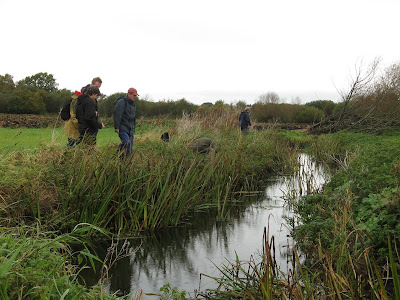
Hawk and Owl Trust Shapwick Moor volunteers Water Vole Surveying
Well used Water Vole hole
Water Vole feeding signs and bankside hole
Great thanks to Philip Noad who took these pictures of the training/survey session.
For more information about Hawk and Owl Trust and how to join go to www.hawkandowl.org 

Saturday, 1 November 2008

Winters first blast! And Why BTO Ringing works!!!

Young wild Barn owl hunting
Fieldfares feeding on hawthorn berries
Snow in October? Well some did get snow, seems here in good olde Somerset we have had a couple of night frost, then a real icy wind from the north east which seems to go straight through you when you are out walking. Suddenly both Redwings and Fieldfares (wintering Thrushes) seem to be everywhere, and in big numbers. With the cold weather has come the first of this winters causalities, and not surprising its a predator who has run out of food first. In this case a young barn Owl. This is a male which was found on a farm on the Mendip Hills. It carried with it a ring number, this corresponded to a ring I put on it on July 23rd, it was the youngest of a brood 4 which hatched from original clutch of 6 eggs. The farm it hatched on was approximately half a mile from the farm it was found on some 3 months later. It was found around 2 weeks ago seemingly downed itself as many young predators do, simply with not enough food.
Transferred by a Somerset Wildlife Trust officer to a Wildlife rehab centre and then back to the Somerset Wildlife Trust (SWT) officer for release. The SWT officer had the good sense to realise that she already had barn Owls on her land (so not a good idea to release another), so called me in, at which time I am then re-united with a wild Owl I had met 3 months earlier. I now have the owl placed in a release aviary on Mendip over land which has no current barn Owls on it, yet does have some great hunting habitat for it. As this bird looks in A1 condition we will not hold it long just make sure of its capability, and of course some good weather before its released. This Owl is now just 3 miles from the farm it was hatched, although its total mileage is probably well over 40 miles, 98% has been as a passenger in a car.

Very special thanks to Kate Lawrence (SWT) and once again to Paula, this in advance of her help with yet some more monitoring, this time with a wild Owl that hatched at her farm.

For more information about the Somerset Wildlife Trust (SWT)go to http://www.somersetwildlife.org/

Tuesday, 28 October 2008

World On the Move Live from Welney


Just got back from doing the live programme today, and I'm now off again, this time to Brixham, but for those of you that missed the programme today (world on the move, BBC Radio 4) , here's some pictures I took at Wildfowl Wetlands Trust, Welney Reserve. The sites and sounds of the Whooper Swans are amazing, you have got to witness this true spectacle. Thanks to Leigh Marshall the reserve manager at Welney, for giving such a knowledgeable insight to these amazing Swans. This trip I will not forget for long time, if ever. You can listen to the programme again by going to the world on the move website and use, listen again http://www.bbc.co.uk/radio4/worldonthemove/

I will update the blog with some more info when I'm back from Devon.